Scabies is a contagious skin condition caused by tiny mites that burrow under your skin and trigger intense itching. Millions of people face this problem every year. Ivermectin for scabies is a clinically proven oral treatment recommended by doctors worldwide.
Oral ivermectin for scabies works by killing the mites and stopping the infestation from spreading further. It is especially useful for moderate to severe cases or when topical treatments have not given the desired results after proper use.
This guide explains exactly how to take ivermectin for scabies, the right dosage based on your body weight, when to take the second dose and important tips to help the treatment work as completely and effectively as possible.
What Is Ivermectin?
Ivermectin is a powerful antiparasitic medicine that works by paralyzing and killing scabies mites along with their eggs. It belongs to the macrocyclic lactone class of drugs and is now widely prescribed in humans for treating various parasitic skin infections effectively.
For mild or localized scabies, doctors sometimes recommend Ivermectin Cream as a topical option applied directly to the affected skin areas. It targets mites on the surface and is often used alongside oral ivermectin for faster and more complete results.
When it comes to ivermectin for scabies treatment, the oral form is most effective for moderate to severe or crusted cases. Your doctor may prescribe it alone or combined with a topical cream depending on how serious the infestation.
How to Take Ivermectin for Scabies?
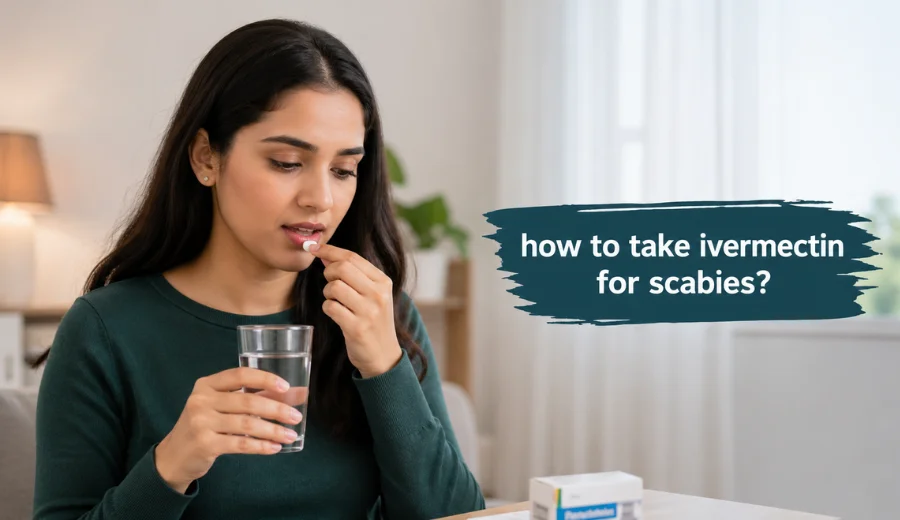
Taking ivermectin for scabies correctly is essential to get the best possible results. Follow these simple steps exactly as prescribed by your doctor to ensure the medicine works fully and the mites are completely eliminated from your body.
Step 1: Take It on an Empty Stomach
Always take ivermectin at least one hour before eating or two hours after a meal. Food, especially a high-fat meal, can change how your body absorbs the medicine and may increase the risk of unwanted side effects during your scabies treatment.
Step 2: Swallow the Tablets Whole with Water
Do not crush, break or chew the ivermectin tablets. Swallow the full prescribed dose at once with a full glass of water. Breaking the tablet can affect how the medicine is released and reduce its overall effectiveness against scabies mites.
Step 3: Take It at the Right Time of Day
Most doctors recommend taking oral ivermectin for scabies in the morning on an empty stomach. This allows you to stay alert and easily monitor for any mild side effects such as dizziness or nausea throughout the rest of the day.
Step 4: Never Self-Medicate or Adjust the Dose
Always take the exact dose your doctor has prescribed based on your body weight. Do not take more or less than recommended. Ivecop 12 Mg (Ivermectin) is one of the commonly prescribed strengths for adults with moderate to severe scabies.
Ivermectin Dosage for Scabies
The standard dose for ivermectin oral for scabies is 200 mcg per kg of body weight, taken as a single oral dose. Your doctor will calculate the exact number of tablets based on your weight.
Here is a general dosage reference:
Ivermectin 3 mg (Iverheal) is a commonly available strength suitable for lower body weights or for precise dose adjustments.
When to Take Second Dose?
A single dose of ivermectin for scabies is often not enough to kill all the mites completely. This is because ivermectin does not kill scabies eggs. A second dose is typically recommended 7 to 14 days after the first dose to kill any newly hatched mites before they mature and reproduce.
Your doctor will advise you on the exact timing of the second dose. In cases of crusted scabies, multiple doses over several weeks may be required for complete clearance. Ivermectin 6 mg (Iverjohn) is commonly used for repeat dosing in adults based on body weight calculation.
If you still experience itching after two doses, do not assume the treatment has failed. Post-scabies itching can last for 2 to 4 weeks even after the mites are gone. This is a normal immune reaction and not a sign of treatment failure.
How Long Does Ivermectin Take to Work?
After taking ivermectin for scabies, the mites begin to die within 24 to 48 hours. However, full results take longer to show. Most people notice a significant reduction in itching within 1 to 2 weeks after the second dose.
Within the first few days, mites stop moving but itching may not reduce immediately. By the first week, the rash begins to fade. For severe or crusted scabies, doctors often prescribe Ivermectin 40 mg to deliver a stronger dose under close supervision.
By 2 to 4 weeks, most symptoms should be significantly reduced or gone entirely. If symptoms persist beyond 4 weeks after completing treatment, consult your doctor as re-treatment may be necessary combined with proper hygiene measures.
Tips for Better Results
Getting the best results from ivermectin for scabies is not just about taking the medication. These additional steps are equally important to ensure complete recovery.
Optimal Administration
Always take ivermectin with water on an empty stomach, either one hour before or two hours after meals, to ensure maximum absorption. Since ivermectin is secreted through sebum at night, taking it in the evening may increase its surface concentration for better results.
A single dose is often not enough for scabies. A second dose taken 7 to 14 days after the first is strongly recommended to eliminate newly hatched mites. The correct dose is always calculated based on body weight, so never adjust it without consulting a doctor.
Environmental Controls (For Scabies)
Wash all bedding, clothing and towels used in the last three days at 60°C or higher to effectively kill any mites remaining on fabric surfaces. Items that cannot be washed, such as stuffed animals or cushions, should be sealed in plastic bags for at least three days.
All household members and close contacts must be treated at the same time, even if they show no visible symptoms. This simultaneous treatment approach is essential to prevent re-infestation, which remains the most common reason for apparent treatment failure.
Safety and Precautions
Only use ivermectin prescribed by a doctor for human use and never use animal formulations like horse paste, as they can be harmful or toxic. If you are researching how to treat scabies effectively, always follow your healthcare provider’s specific instructions, as they will tailor the dose to your individual condition.
Intense itching may continue for up to two weeks after treatment as mites gradually die off. This is a completely normal immune response and does not indicate treatment failure. Consult your doctor if symptoms persist beyond four weeks after completing the full course.
Conclusion
Ivermectin for scabies is a proven, effective treatment when taken correctly. The key is to follow your doctor’s prescribed dose, take the medication on an empty stomach and complete both doses as recommended. Combined with proper hygiene and treating all household members simultaneously, ivermectin gives you the best chance of clearing scabies quickly and completely.
If you have any concerns about your dose or the progress of your treatment, always consult a qualified healthcare provider. Do not rely on self-diagnosis or self-medication for conditions like scabies.
FAQs
Q1. Can I take ivermectin for scabies without a prescription?
No, you should not take ivermectin for scabies without a doctor’s prescription. The correct dose depends on your body weight and the severity of the infestation. Taking the wrong dose can be ineffective or cause unwanted side effects. Always consult a licensed doctor before starting treatment.
Q2. How many doses of ivermectin are needed to cure scabies?
Most doctors prescribe two doses of ivermectin for scabies. The first dose is taken on day one and the second dose is taken 7 to 14 days later. This second dose is necessary to kill any newly hatched mites that were not affected by the first dose.
Q3. Can ivermectin for scabies be taken with food?
No, ivermectin should be taken on an empty stomach for best results. It must be taken at least one hour before eating or two hours after a meal. Taking it with food, especially a fatty meal, can alter how the body absorbs the medicine and may increase the risk of side effects.
Q4. How do I know if ivermectin is working for scabies?
You will notice the mites begin dying within 24 to 48 hours of taking ivermectin for scabies. However, itching may continue for 2 to 4 weeks even after the mites are gone. This is a normal immune response and does not mean the treatment has failed. Consult your doctor if symptoms persist beyond 4 weeks.
Q5. Is ivermectin safe for children with scabies?
Ivermectin for scabies is generally considered safe for children who weigh 15 kg or more. The dose is calculated at 200 mcg per kg of body weight, same as for adults. For children below 15 kg or infants, doctors usually recommend topical treatments instead. Always follow your doctor’s advice for pediatric use.